

The number nobody types in by hand
You open the app at six, the favourite is 1.90, and by the time you’ve finished arguing with yourself the same selection is 1.74. Here’s the short version of how sportsbook odds are set: a trading team converts data into a probability estimate, converts that probability into a price, adds a margin, and then keeps moving that price as money and information arrive. No single person sits there deciding who will win.
That function has become specialist enough that operators and suppliers hire for it at senior level. Pythia Sports, which supplies pricing, trading and risk management services for horse and greyhound racing, recently appointed Ben Hutton as Head of Trading after two decades running racing products on the bookmaker side at Gala Coral and its successor businesses through to Entain. His brief covers trading margins, how the racing product is presented to customers, and the tools the trading team uses, and he has been building AI-based trading models. That is the shape of the job: margin, presentation, risk, tooling. Not prediction.
What a trading desk actually does all day
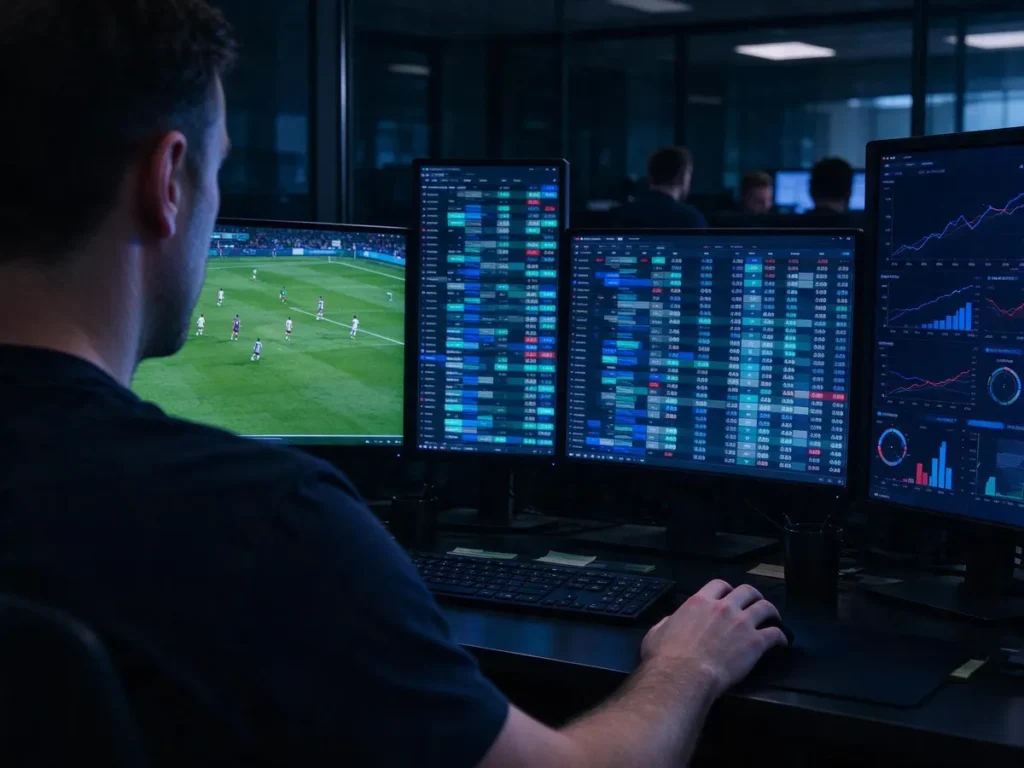
A trading desk runs a continuous risk-management operation, not a one-off price-setting event. Compilers or models produce an opening line, traders monitor exposure across every selection in the market, and prices are adjusted whenever new information or new liability makes the current price uncomfortable. The market opens, it never really closes until the event starts.
The inputs are less exotic than people assume. Historical results and performance ratings, recent form, home and away splits, confirmed and rumoured team news, injuries, travel and rest days, pitch and weather, and for racing, going, draw and trainer data. For liquid markets, the single most powerful input is other markets: betting exchanges and the sharpest competing books act as a reference price, which is why lines across the industry tend to converge.
From probability to price: where the margin comes in
The model gives a probability; the margin turns it into a price the book can profit from. If the desk’s model says a team wins 50% of the time, the fair price is 2.00. Publishing 2.00 would hand the book a zero expected return before costs, so the quoted price is shaded down, to 1.91 or thereabouts. That shading is the vig, also called the overround, and it is the whole business model.
Algorithms and humans: who overrides whom
On high-volume markets, automation does most of the work and the trader supervises. Football match odds, tennis, basketball totals: models price them, feeds update them, and a human intervenes on exceptions. On thin markets, niche competitions, obscure props, unusual racing conditions, manual judgement carries far more weight because there is less liquidity and less reliable data to lean on.
Traders also override for reasons that have nothing to do with probability. A customer with a strong record triggers a reprice or a reduced limit. An unverified injury rumour on social media gets a market suspended until it is confirmed. A correlated book across several markets gets trimmed because the combined liability, not any single bet, is the problem.
How bookmakers price markets: a worked two-way example
Quoted odds are always worse than the trading desk’s own estimate of the outcome, and the gap is measurable. Take a two-outcome market the desk genuinely believes is a coin flip. Fair odds are 2.00 on each side. Now price it with a margin of roughly 5%.
| Selection | Desk’s estimate | Fair odds | Odds offered | Implied probability |
|---|---|---|---|---|
| Team A | 50% | 2.00 | 1.91 | 52.36% |
| Team B | 50% | 2.00 | 1.91 | 52.36% |
| Market total | 100% | 100% | — | 104.7% |
The implied probabilities add up to roughly 104.7% instead of 100%, since 1 ÷ 1.91 is about 52.36% per side and two of those come to 104.72%. That extra 4.7 points is the overround, and it is why your payout is smaller than a genuinely fair settlement would be. At 1.91 you need to win about 52.4% of your bets simply to break even, not 50%. On a lopsided market the mechanic is identical: a true 70/30 contest prices fairly at 1.43 and 3.33, and with the same margin applied you are offered something closer to 1.36 and 3.17.
This is the cost most casual bettors never quantify. It is not a fee you can see on a statement. It is baked into every price you have ever taken, on every book, and no amount of clever timing removes it.
Myth: the line moved because the book changed its mind
Pre-kickoff movement is mostly risk management and new information, not a revised forecast. A line that drifts from 1.90 to 1.74 is rarely the desk announcing it now believes in that team; it is the desk responding to what has arrived since it opened the market.
The usual drivers, in rough order of how often they matter:
- Confirmed team news, especially a key player ruled out or unexpectedly starting
- Weather that changes how a game is likely to be played, and in racing, the going
- Heavy one-sided volume from recreational customers creating uncomfortable liability on one side
- Stake from customers the book rates highly, which is treated as information rather than just exposure
- A reference market moving, forcing everyone else to follow or get picked off
Steam moves
A steam move is a fast, broad reprice of the same selection across multiple books in a short window. It happens when respected money hits one book and competitors adjust defensively rather than wait to be arbitraged. By the time the move is visible on an odds comparison screen, the price that caused it has usually gone. Chasing steam is mostly chasing a train that already left.
Reverse line movement, and what it actually tells you
Reverse line movement is when a price shortens despite most of the tickets going the other way. If 70% of bets are on the favourite and the favourite’s price gets longer, the implication is that a smaller number of larger, better-respected stakes landed on the underdog. It is a signal about who is betting, not a prediction. Plenty of reverse moves are followed by the public side winning anyway, and the signal is much noisier in markets with thin liquidity.
In-play trading runs on a far shorter clock
Live betting odds are produced by automated models updating continuously off a data feed, with traders supervising rather than compiling each price. Pre-match odds compiling can take hours or days of model work and manual review for a single market. In-play pricing recalculates every few seconds off score, time remaining, red cards, possession, wickets and overs, with a risk window measured in seconds instead of days.
That speed creates a specific weakness, and it is worth understanding rather than trying to exploit. The data feed, the model, the operator’s platform and your phone all add latency. A goal can be scored while the market is still quoting the pre-goal price for a moment. Books handle this by suspending markets at the first sign of a dangerous phase of play, by shortening the window, and by voiding bets placed on a stale price under their terms. If you think you are beating a live price because you are watching a faster stream, read the bet acceptance and void clauses in the terms before you build anything on it.
Timing a bet: what works, and what is folklore
There are two defensible positions here. One says bet early, because the opening line is the softest the market will ever be and your estimate has the best chance of being ahead of it. The other says wait, because team news resolves real uncertainty and betting before a lineup is confirmed means paying for information you don’t have.
Both are right for different people. Betting early only beats waiting if your own probability estimate is genuinely better than the market’s at that moment. If your edge is simply reading the same injury report everyone else will read an hour later, you are not early, you are uninformed. For most readers of this article, I’d take the second position: wait for confirmed news, and spend the energy you’d have spent on timing on line shopping instead.
Line shopping is the part with arithmetic behind it. Taking 1.83 when 1.91 was available at another licensed book costs you roughly 4% of turnover. Across a hundred bets of ₹1,000 that is around ₹4,000 handed over for nothing, which is comparable to the entire house margin you are already paying. Holding accounts at two or three books and checking before you stake does more for your bottom line than any theory about when lines move.
Closing line value, or CLV, is the comparison between the price you took and the final price before the event started. Bettors track it because the closing line is the market’s best-informed estimate, so consistently beating it suggests your selections are at least ahead of the market’s information curve. Treat it as a diagnostic, not a promise. The closing line itself contains the overround, so beating the close by a sliver still leaves you underwater, and a sample of twenty bets tells you nothing. It is also not available to everyone equally: accounts that beat the close regularly tend to find their limits cut.
What none of this settles is whether CLV means much at recreational stakes. The benchmark was built around people betting into liquid markets at size; if you are placing ₹500 on a weekend fixture, the honest answer is that understanding odds movement makes you a better-informed customer, not a profitable one. The margin is still there, the house still holds the edge over time, and no timing method removes either. Set a deposit or loss limit before you bet, treat the money as entertainment spend rather than income, and use the operator’s self-exclusion and cool-off tools if betting stops feeling optional. If you’re in India, support is available through national helplines and the responsible gambling tools every licensed operator is required to provide.