

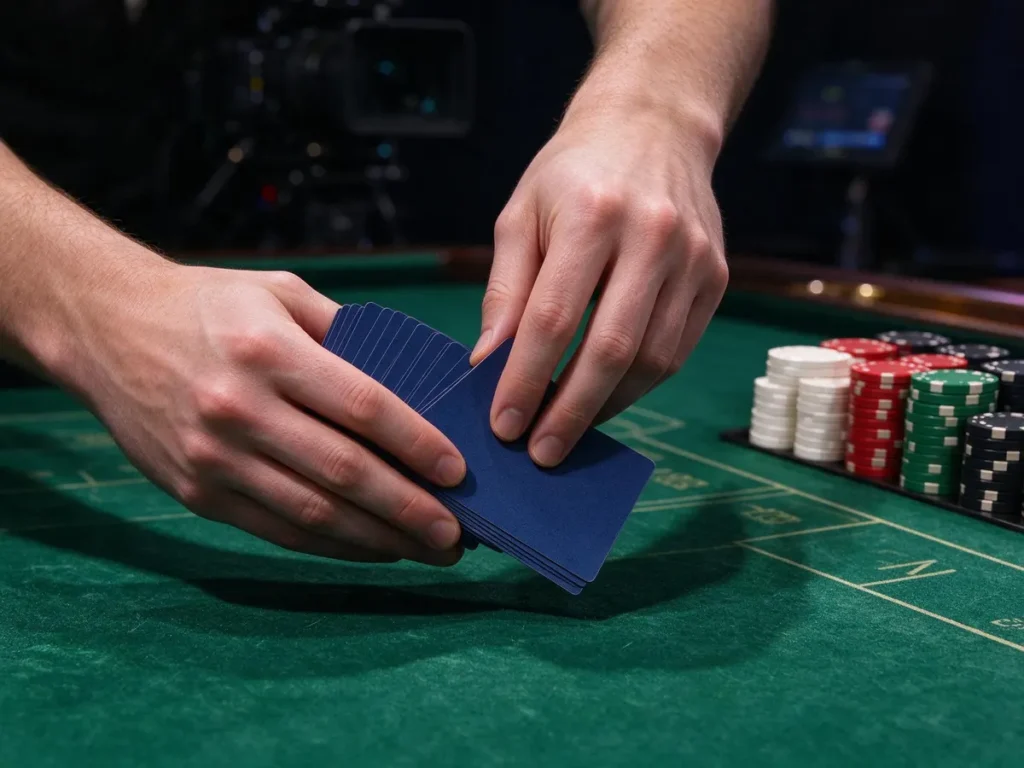
Watch a live roulette table for ten minutes and count what the dealer actually does. Bets close, the ball drops, the winning number is called, losing chips are swept, payouts go out in a fixed order, the next round opens. No hesitation, no recounting, no asking the pit for help. That rhythm is not personality. It is drilled, and it is the reason casino dealer training is a line item big operators spend real money on rather than a nice-to-have.
MGM Osaka has backed a dealer course before Japan’s first IR opens
MGM Osaka has endorsed a casino dealer training course ahead of the opening of Japan’s first integrated resort, according to trade outlet GGRAsia. That is the full extent of what is confirmed in the report available to us. Specific curriculum content, course length, intake numbers and provider arrangements are not something we can verify here, and anything stated about them elsewhere should be checked against the operator’s own announcements.
The timing is the interesting part. Japan has no existing commercial casino workforce. Where Macau, Manila or Singapore could poach experienced croupiers from a neighbouring property, Osaka has to build a dealer pool from zero, in a market where table games operations are brand new to almost everyone who will work in them. Endorsing a course before the doors open is what you do when the hiring problem is bigger than the building problem.
What a professional dealer course actually teaches
Professional casino dealers are trained on three things that are easy to describe and hard to do: mechanical handling, rules and payout mastery, and procedure under observation. The skills below are general industry standards, not claims about the Osaka course.
The hands
Cutting and spreading chips, sizing stacks so a camera and a floor supervisor can read them at a glance, dealing cards cleanly without exposure, clearing a layout in a consistent sequence. A dealer who has to look at their hands cannot look at the table, and watching the table is most of the job.
The arithmetic
Payout tables are memorised, not calculated. A roulette dealer paying a split at 17 to 1, a corner at 8 to 1 and a straight-up at 35 to 1 across a dozen players does the mental work faster than the players can check it. Baccarat commission, blackjack 3:2 versus 6:5, side-bet schedules: all of it has to come out right the first time, because an error that favours the player is a loss and an error that favours the house is a complaint and a surveillance review.
The procedure
This is where game integrity actually lives. Announcing chip changes out loud, keeping hands clear of the layout when the camera needs a view, never touching a player’s chips after the bet closes, calling the supervisor rather than deciding a disputed bet alone. Dealer etiquette, in the trade sense, is less about charm and more about doing everything in an order that can be reconstructed later from footage. Composure matters too, because a dealer who gets flustered by an argumentative player starts making handling mistakes, and mistakes are what cheats look for.
Two ways to read a training push, and the one I’d back
There are two defensible readings of an operator investing heavily in dealer standards, and they lead to different conclusions about whether players should care.
The first reading treats it as hospitality. Table games are a service product; the dealer is the face of a multi-billion-dollar property; a warm, fluent croupier keeps guests at the table longer and makes them come back. On this view, training is marketing spend with a uniform, and it has nothing to do with whether the game is fair, because the mathematics of baccarat does not care who pushes the shoe.
The second reading treats it as integrity infrastructure. Error rates, procedural consistency and anti-cheating awareness are what a regulator inspects and what surveillance depends on. A poorly trained floor leaks money, generates disputes and creates openings for collusion, which is exactly the outcome a brand-new jurisdiction cannot afford on its first attempt.
The hospitality reading is not stupid, and in commercial terms it is probably where most of the budget justification sits. But for a first-of-its-kind licensed casino in a country with no dealer labour pool and an unusually cautious public debate about gambling, the integrity reading is the one that explains the urgency. You do not front-load training before opening to be charming. You do it so the first regulatory inspection is uneventful.
Here is the condition almost nobody checks before cheering for better dealers. A well-trained dealer runs a faster table. House edge is applied to every unit wagered, so expected loss scales with total turnover, not with time spent sitting down. Thirty hands of blackjack an hour at a fumbling table and sixty at a sharp one carry the same edge per hand and roughly double the expected cost per hour. Professional casino dealers make the game cleaner, better supervised and fairer to settle. They also make it more expensive per hour to play. Both statements are true at once, and the marketing material only ever mentions the first.
Where the live dealer studio copies the casino floor
Online live dealer casino standards rest on the same fundamentals as a land-based pit, because the product is the same product with a camera in front of it. A licensed live casino studio hires and trains dealers for pacing, clear announcements, correct payouts and procedural consistency, then adds requirements a floor dealer never faces: speaking to a lens rather than a table, reading chat without losing the round, keeping a hand visible for a broadcast feed.
What changes is who absorbs the errors. In a live streaming studio, bet settlement is handled by software reading the physical outcome, often with optical recognition of the wheel or the cards, so a payout arithmetic slip is largely engineered out. What the dealer still controls is everything that happens before settlement: whether the shoe is handled correctly, whether the round is called clearly, whether a misdeal is resolved by procedure or improvisation. A studio dealer’s mistakes are rarer but far more public, since every round is recorded and a few thousand people may be watching the same hand.
Signs of a live dealer table worth sitting at
Live dealer game quality is checkable before you place a bet. The things that genuinely indicate a well-run table:
- A named game provider and a licence you can verify, listed in the site footer or the game information panel rather than implied by a logo.
- Rules, payouts and side-bet odds displayed in the interface, not buried in a help file.
- Consistent round timing, with a visible betting timer that actually closes when it says it does.
- Bet settlement that resolves immediately after the outcome, with the result and the payout shown in your history.
- A stream that holds resolution during the deal or the spin, since a compressed feed at the wrong moment is the one thing you cannot audit yourself.
- A dealer who announces outcomes clearly and refers disputes upward instead of improvising a ruling on camera.
Notice what is not on that list: how friendly the dealer is. Warmth is pleasant and it is also the easiest thing to fake. Licensing, published rules and verifiable round history are the parts that survive a dispute.
What Indian players actually sit down to
Among Indian players, the busiest live tables are the ones that need no explanation. Teen Patti and Andar Bahar carry straight over from home and family play, so the rules cost nothing to learn. Dragon Tiger is a two-card decision with a fast cycle. Live roulette and live blackjack draw the crossover crowd who want a recognisable international table game.
The games differ sharply in how much your decisions matter, which is worth knowing before you pick one:
| Game | Decision involved | Why it travels well |
|---|---|---|
| Teen Patti (live) | Bet placement only, in most live formats | Familiar from social play |
| Andar Bahar | Side selection, plus side bets | One rule, very fast rounds |
| Dragon Tiger | Pick a side or a tie | Shortest round cycle on the floor |
| Live roulette | Bet selection across the layout | Universally understood, single-zero wheels carry a 2.7% house edge |
| Live blackjack | Hit, stand, split, double | Playing decisions genuinely change the edge |
Fast rounds are the trap in that table. Dragon Tiger and Andar Bahar feel cheap because individual stakes are small, while the turnover per hour is higher than almost anything else in the live lobby.
What the Osaka standard may and may not change
A new jurisdiction writing its dealer standards from scratch tends to raise the floor for everyone, because the training material, the procedural manuals and eventually the people themselves circulate through the industry. If Osaka’s intake becomes a benchmark, studios supplying Asian live tables will feel it in hiring expectations before players feel it in the product.
What it will not change is the maths. Better dealers mean fewer errors, cleaner supervision and quicker settlement. They do not alter the house edge, and a smoother table moves money faster, so decide your deposit limit and your session length before you sit down rather than after. If play stops being entertainment and starts being recovery, use the operator’s deposit limits, cool-off or self-exclusion tools. Whether Japan’s first integrated resort actually sets the standard, or simply imports the one Macau and Singapore already run, is something only the first few years of operation will answer.