

How many of the games on your casino’s homepage did that casino actually build?
Almost none of them. That single fact is what online casino platform partnerships are about, and a recent example makes it concrete: according to Focus Gaming News, the content studio ICONIC21 has signed a distribution agreement with Advabet, also known as Adwa, a bespoke iGaming platform provider. The reported deal covers slots, virtual games and live casino products, starting with a rollout across Adwa’s own B2C brands before extending to its wider B2B ecosystem. Featured content includes flagship titles from Gravity Games and the virtual game iDealer Blackjack.
No financial terms, territories or launch dates were reported, and I am not going to guess at them. What the deal is useful for is explaining the plumbing behind every casino lobby you have ever opened, and the one thing that plumbing does not tell you about the site you are depositing into.
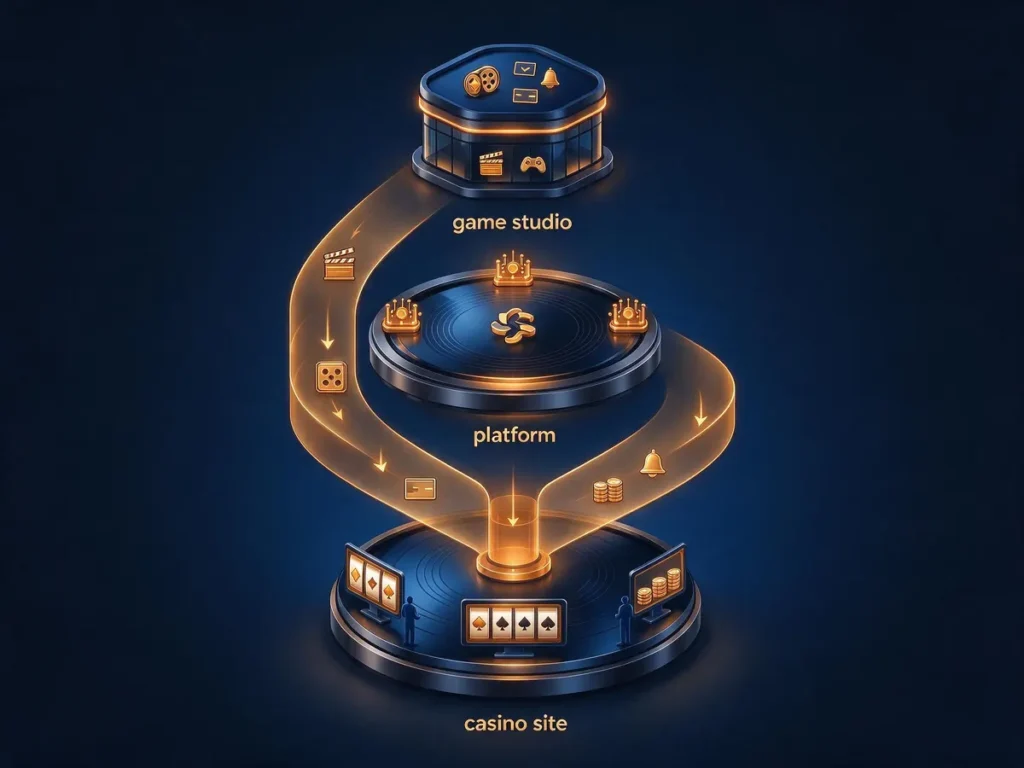
Three layers sit behind every game you open
A casino lobby is assembled from three separate businesses, and confusing them is the root of most bad decisions players make about where to play.
The content provider, or game studio
This is the company that designs and codes the game: the maths model, the art, the RTP configuration, the RNG. ICONIC21 sits here. A studio rarely holds your money or your account; it licenses its titles out and takes a revenue share. When you want to judge a game’s quality, the studio name is what matters, which is why it is worth learning to read a slot studio’s RTP and volatility disclosures”>read a slot studio’s RTP and volatility disclosures rather than trusting a lobby thumbnail.
The aggregator or platform provider
Casino game aggregators bundle hundreds of studios behind a single API integration, so an operator signs one contract instead of forty. Platform providers go further and supply the whole back end: wallet, bonus engine, reporting, sometimes a full white-label platform that a brand simply paints its logo onto. Adwa, per the reporting, is a platform provider of this kind, with both its own consumer brands and B2B clients. This layer is the reason a new studio can appear across dozens of sites in the same month.
The operator
The brand you register with, deposit into and complain to. It holds the licence, runs KYC, processes your UPI withdrawal and owns the terms you agreed to. Everything above it is interchangeable. The operator is not.
Keep that hierarchy straight and the rest of this article mostly writes itself.
Why operators keep signing distribution deals
Cost and speed, in that order. Integrating a single game studio directly means contract negotiation, technical work, certification checks and ongoing account management. Multiply that by the 60 to 100 studios a competitive lobby now carries and the maths stops working for anyone but the largest operators.
Aggregation collapses that into one pipe. A platform signs the studio once, and every operator on the platform can switch the content on. For the studio, the incentive mirrors it: one deal with a platform like Adwa puts its portfolio in front of that platform’s B2C brands and its B2B clients at once, which is exactly the phased structure the ICONIC21 agreement is described as following. Portfolio expansion for the studio, catalogue depth for the platform. Igor Drobaha, head of casino at Adwa, framed the content as adding depth to the platform’s entertainment offering, and Alina Mihaela Popa, CCO at ICONIC21, pointed to Adwa’s flexibility as the reason for the pairing. That is the whole commercial logic, stated politely.
Myth: a partnership announcement means new games in your lobby
It usually means nothing of the sort, at least not soon. Distribution deals are announced at signing, not at launch, and most roll out in stages. The ICONIC21 agreement is reported to begin with Adwa’s own B2C brands and only then widen to the broader B2B ecosystem, which means operators further down that chain may see the content months after the headline.
Beyond sequencing, operators curate. A platform can offer 12,000 titles and an operator will still switch on a fraction of them, filtered by what its players actually open, what its licence permits in a given market, and what the commercial terms look like per title. A press release is a statement of intent between two companies. It is not a product update for you.
Myth: the same game plays the same everywhere
It does not, and this is where platform and integration quality genuinely reaches the player. The maths engine for a given slot is the studio’s, but what wraps it is not.
Load time, in-lobby search, how cleanly the game resizes on a mid-range Android phone, whether the session survives a switch from Wi-Fi to mobile data, how fast the balance updates after a round: all of that is the platform’s integration work. Platform uptime is the same story. When a lobby stalls mid-session or a live table drops out, the operator’s name is on the error message, but the fault is often one layer down.
There is also a harder point that iGaming software suppliers do not advertise. Many studios ship the same title in more than one RTP configuration, and the operator or platform chooses which build goes live. A game you know at 96% can appear elsewhere at a materially lower return with identical art and identical reels. The only defence is checking the RTP disclosure inside the game’s own information panel, on the site you are playing on, every time. If a site hides that panel or shows no figure at all, that is your answer about how much it wants you to know.
Myth: more content partners means a safer casino
A large game library tells you an operator has money and distribution. It tells you nothing about whether that operator will pay you.
These are two unrelated variables and players merge them constantly. Content deals measure scale and investment; they are signed on commercial terms, not on a vetting of the operator’s withdrawal behaviour. A platform provider’s job is to supply infrastructure to its clients, not to guarantee their conduct to you. I would not treat a long provider list in a site footer as a safety signal, and I would be actively suspicious of a site that leads with “5,000+ games” and buries its licensing details.
The condition almost nobody checks is the one that decides everything: which regulator’s licence covers the specific domain you are depositing into, and whether that regulator will actually hear a complaint from a player in your country. Operators run multiple licences across multiple domains. The games are the same; the recourse is not. Verify the licence number on the regulator’s own public register, not on the casino’s own page about it. A logo in a footer is an image file.
What to check before you deposit
Run this before the first deposit, not after a disputed withdrawal.
- Find the licence number and operating company name in the site footer, then look that number up on the regulator’s own register and confirm the domain you are on is listed.
- Check whether named studios are shown with the games, not just a generic “slots” category. Named providers mean traceable content.
- Open a game’s information panel and locate the stated RTP. Compare it against the studio’s published figure for that title where available.
- Look for RNG certification or testing-lab references, usually credited to an independent testing house, and treat their absence as missing information rather than proof of anything.
- Test the mobile build before funding the account: load a few games, check load times, rotate the screen, switch networks.
- Read the withdrawal section of the terms for processing times, KYC triggers, minimum and maximum amounts, and whether UPI is supported for payouts as well as deposits.
- Make one small deposit and one small withdrawal before committing anything larger. Payment reliability is the only part of a casino you cannot assess from the outside.
Seven checks, maybe twenty minutes. The game library takes you five seconds to admire and is the least informative thing on the page.
What the consolidation trend actually leaves open
Deals like ICONIC21’s with Adwa are routine now, and the direction is clear enough: content keeps pooling into fewer, larger distribution layers, and lobbies across unrelated brands keep converging on the same catalogue. The practical consequence for players is that game selection is becoming a weak differentiator between casinos. If three sites draw from overlapping aggregators, their libraries will look much the same.
What stays genuinely unsettled is accountability. As more of the player-facing experience is built by companies you have no contract with, it gets harder to tell whether a stalled game, a missing RTP figure or a silent account is the operator’s doing or something further up the chain. Nobody in the industry has solved that, and the current answer is that the operator owns it because the operator holds your money. So judge the operator.
And keep the obvious in view: every one of these games carries a house edge, the long-run return belongs to the operator, and no partnership, provider or platform changes that. Set a deposit limit, treat the spend as entertainment cost, and use the self-exclusion and cool-off tools if the sessions stop feeling like a choice.